


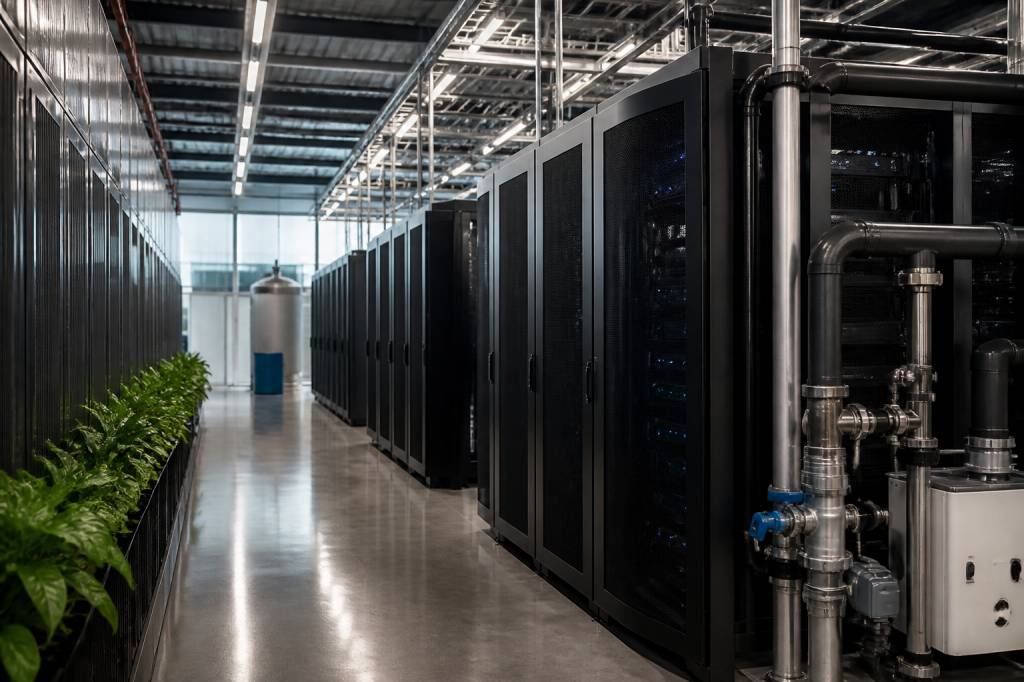
Artificial intelligence may feel weightless—just code, prompts, and answers appearing on a screen like ripples on a calm pond. But behind every model is a very physical world: servers, chips, cooling systems, electricity, and, often overlooked, water. In data centers, water is not a side note. It is part of the hidden machinery that keeps AI running without overheating like a river in midsummer.
So how does AI use water in data centers, and what does that mean for the environment? The short answer: AI itself does not “drink” water, but the infrastructure that trains and runs AI systems can consume significant amounts of water, both directly and indirectly. The longer answer is more nuanced, and far more important for anyone concerned with water quality, sustainability, and the future of digital infrastructure.
Why data centers need water in the first place
Data centers are built to process enormous volumes of data nonstop. AI workloads, especially training large models, generate intense heat because thousands of processors are working at high speed for long periods. If that heat is not removed efficiently, equipment can fail, performance drops, and energy use climbs even higher. Water becomes one of the most common tools for cooling this digital heat engine.
In many facilities, water is used in cooling towers or evaporative cooling systems. These systems work a bit like the body’s own sweat response: water absorbs heat and then evaporates, carrying that heat away. It is effective, relatively inexpensive, and often more energy-efficient than relying only on air conditioning. But it comes with a trade-off: water is consumed in the process, and some is lost to evaporation. That means it must be continually replaced.
Not all data centers use water in the same way. Some rely heavily on water-based cooling, while others use air cooling, liquid cooling loops, or hybrid systems. The choice depends on climate, cost, energy efficiency targets, and the type of computing being done. AI training clusters, which are among the most power-hungry workloads, often push operators toward more advanced cooling strategies, including systems that may still depend on water somewhere in the chain.
Direct water use: what is actually being consumed?
When people talk about water use in data centers, they usually mean direct operational water use. This includes water used for cooling, humidification, and sometimes on-site maintenance. Cooling is by far the biggest component.
Here are the main ways water is directly involved:
The exact amount of water used varies dramatically. A small, modern facility with efficient cooling might use relatively little. A large AI-oriented data center in a hot, dry region can use a great deal more. Climate matters. In a dry desert environment, evaporative systems can be effective, but they also intensify local water demand, which is not a trivial issue when aquifers are already under pressure.
This is where the story becomes less about technology alone and more about geography, governance, and ethics. A server farm in a water-rich area is one thing; the same facility in a drought-prone basin is another entirely. The river may be wide on the map, but local availability can be much more fragile than the map suggests.
Indirect water use: the electricity connection
Water use in AI is not limited to what happens inside the data center walls. There is also indirect water consumption linked to the electricity needed to power the servers and cooling systems. Power plants often use water for steam generation, cooling, or emissions control, depending on the energy source and technology.
This means that even if a data center uses minimal on-site water, it may still drive water demand elsewhere through electricity consumption. This is especially relevant for AI because training large models can require substantial amounts of energy. The more energy consumed, the more water may be used upstream in the power generation mix.
The environmental impact therefore depends on two things at once:
A facility powered by renewable energy in a region with low water stress can have a much lighter water footprint than one supported by fossil-fuel-heavy electricity in an arid zone. In other words, the same AI query can have very different water consequences depending on where and how it is served. Digital clouds, as it turns out, still cast very earthly shadows.
Training AI versus using AI: not all workloads are equal
It is tempting to imagine that every AI interaction has the same environmental cost. In reality, there is a major difference between training a model and using it.
Training is the heavy lift. It can involve days or weeks of continuous computation on specialized hardware. During this phase, heat generation is intense, and cooling demand rises accordingly. Water use can therefore be much higher during training than during ordinary inference, which is the process of generating answers after a model is already trained.
Inference is what most users experience when they ask a chatbot a question, generate an image, or run an AI-assisted search. A single request usually consumes far less energy and water than a training run. But because AI use is becoming widespread, the cumulative effect matters. Millions or billions of small requests can add up to significant resource demand, especially when models are large and the infrastructure is not optimized.
Think of it like a river system. One thunderstorm may not shape the watershed, but a season of steady rain will. Likewise, one prompt may seem negligible, but the total volume of AI interactions can influence the scale of water and energy use across the digital ecosystem.
Environmental impacts beyond water quantity
Water impact is not only about how many liters are used. It is also about where the water comes from, what quality it has when withdrawn, and what happens after use. A cooling system may not contaminate water directly, but it can still strain local resources or alter water temperature and availability.
Here are the main environmental concerns:
In regions already facing water stress, a new data center can become a political and ecological flashpoint. Communities may ask a very reasonable question: should a facility that supports digital convenience be drawing water from the same system that supplies farms, wetlands, and homes?
This is not a hypothetical concern. Around the world, planners and local communities are increasingly scrutinizing the siting of data centers. The debate often mirrors broader environmental questions: who benefits, who pays, and who bears the risk when resources are scarce?
Can AI also help reduce water use?
Yes, and this is where the story becomes more interesting. AI is not only a water consumer; it can also be a tool for water efficiency. The same pattern-recognition systems that power chatbots can help optimize cooling, detect leaks, improve irrigation, and forecast demand across water networks.
In data centers themselves, AI can be used to manage cooling more precisely. Instead of running cooling systems at a fixed setting, machine learning models can adjust temperatures, airflow, and pump speeds in real time based on actual server loads and weather conditions. This can reduce both energy and water use. Some operators have reported meaningful efficiency gains by using AI-driven controls to fine-tune cooling rather than overcooling the entire facility “just in case.”
Outside the data center, AI can support broader water management:
That is the paradox at the heart of modern technology: the same intelligence that consumes water can, if designed responsibly, help protect it. The key is whether the system is built with efficiency, transparency, and environmental accountability in mind.
What makes an AI data center more water-friendly?
Not every data center has to become a water hog. There are practical strategies that can significantly reduce impact. The best facilities treat water like a precious current, not an infinite stream.
Some of the most effective approaches include:
There is no single silver bullet. The best outcome usually comes from combining multiple strategies. A data center that uses efficient hardware, smart cooling controls, recycled water, and low-carbon power will typically have a much lighter footprint than one relying on conventional designs and thirsty local resources.
How transparency can shape better choices
One of the biggest challenges in this field is visibility. Many users know that AI runs “in the cloud,” but few can see what the cloud is doing to local rivers, reservoirs, and power systems. Better reporting can change that.
When companies disclose water usage, cooling methods, energy sources, and site locations, they make it easier for communities, regulators, and customers to assess trade-offs. This kind of transparency is especially important in water-stressed regions. A facility should not be a silent neighbor, humming away while local aquifers quietly decline.
Clear metrics also help compare solutions. For example, a company may claim that a new cooling system is “sustainable,” but what does that mean in practice? Does it lower freshwater withdrawals? Does it use recycled water? Does it reduce both energy and water intensity? Without evidence, sustainability remains more slogan than solution.
What should users and businesses pay attention to?
If you use AI casually, you do not need to panic every time you ask a question. But awareness matters. The environmental footprint of AI depends on usage patterns, model size, and the infrastructure behind the service. Businesses adopting AI at scale should pay close attention to where their providers host data centers and how those facilities manage water.
Useful questions include:
These questions are not just for environmental specialists. They matter to procurement teams, IT leaders, policymakers, and anyone trying to make digital infrastructure compatible with long-term water resilience.
A future where digital growth and water stewardship can coexist
AI is likely to keep expanding, and data centers will remain the backbone of that expansion. The environmental question is not whether digital infrastructure should exist, but how it can evolve without draining the waters that sustain communities and ecosystems.
That future is possible. It will require smarter cooling systems, better siting decisions, cleaner power, more recycled water use, and honest reporting. It will also require a shift in mindset: every byte has a footprint, and every footprint lands somewhere real. Often, that “somewhere” is a watershed already under pressure.
If we want AI to serve the public good, it must be built like a well-managed river basin: balanced, monitored, and respectful of limits. Technology can be a powerful current for progress, but only if it learns to move in harmony with the world that supports it.